Agentic Engineering vs. Three Tiny Humans
On July 21st, Guardian Driven Development hit 1.0. First tag the repo has ever worn, four months almost to the day after I first wrote about it here.

On July 21st, Guardian Driven Development hit 1.0. First tag the repo has ever worn, four months almost to the day after I first wrote about it here.
Then I spent the next couple of days doing… approximately nothing with it. No announcement, no victory lap, just a strange decompression. It turns out that after months of “one more session to clear the path,” the path being clear is disorienting. So another whole month passed, just being productive and enjoying life. But as the next point release is firming up I am giving finishing this another try :-)
I kept coming back to a crazy new reality:
The productivity (and morale!) boost from GDD has probably outweighed the productivity cost of raising three tiny humans.
Anyone with small children knows what they do to focused time. It doesn’t shrink — it shatters. You get fragments: fifteen minutes here, a nap-length window there, an evening that ends the moment someone has a bad dream. The pre-kids me with whole uninterrupted weekends would look at my current life and declare serious project work impossible, even hobby tinkering unlikely.
And yet, I’m fairly confident that no-kids-no-GDD me would have shipped less than three-kids-with-GDD me actually has. Not less per hour — less, period.
That’s not because the AI writes code fast (it does, but that’s the boring part). It’s because GDD is built around exactly the failure mode fragmented time creates: losing the thread. The Thalamus remembers where every effort stood when the bad dream happened. Sessions re-orient themselves in seconds instead of me spending my precious fragment reconstructing context (they can even leave messages for each other). “Arc” style larger projects survive across machines, days, and interruptions, and a dashboard adds visibility. The fifteen-minute fragment becomes usable, because neither of us starts from zero.
Another angle hides in that “(and morale!)” bit. I’m doing more and better off the nerdy computer topics too. Measuring the basement for better HVAC Manual J load numbers and ductwork options? Check! Feeling like I can volunteer more with local community groups? I got the energy. Networking with other professionals and locals on topics that seem completely unrelated? Exciting to tie it all together! Not to sound like a motivational speaker advertisement, but it is wild how just a trickle of more meaningful activity can motivate you to keep that going on a path to some sort of greater level of self-actualization.
I’m managing to also touch grass. But I might still have used my agent to find the optimal grass!
(Well, at publish time it has been another month, but I don’t want to redo all the numbers …)
Counting GDD itself plus everything built with it — the apps, the platform stack, the civic sites, even the shared-memory hoards, but excluding the big pre-existing projects, forks, and vendored code — the last five months (the earliest script pieces predate the March announcement) come to roughly 220,000 lines across ~1,500 files. About 70k of that is GDD and its community-config layer; about 130k is things built with it; the rest is the living memory the methodology runs on — some 40k lines of curated notes, arcs, and audit trails that my old workflow simply never produced as an artifact at all.
For rough comparison, that’s approaching the size of Terasology - which was built by a community over a decade-plus. Different composition, absolutely — there’s a lot of markdown and YAML in my pile — but GDD treats the design docs and the shared memory as product, not just overhead, and one todo is post-processing that further into Architectural Decision Docs and similar for the future.
If you’re an AI-tooling nerd, here’s the frame I’d offer: GDD sits deliberately between two poles that get all the attention.
On one side, the cautious camp: AI on a short leash, autocomplete-plus or agentic-curious, serious control with limited reach. On the other, the YOLO swarm — a thousand agents, minimal review, maximum throughput, and whatever happens to code quality happens (I wrote about my conflicted feelings about Gas Town last time - good and I love that it exists, but it is for specific audiences).
GDD is my attempt at the interesting middle: agents with real autonomy inside deterministic guardrails. A permission hook that denies dangerous shell patterns before they run and teaches the agent the house style with corrective messages. Trust gates where activating community config requires a human to approve trust — fingerprinted, so if it changes later, trust goes stale and you get asked again. Commit, issue, and PR attribution that hard-errors rather than guess who did what. Every commit through a template that demands the why.
My favorite proof came at the very last step. When the tiny release commit was ready, the agent tried to push it to main — and got refused, because branch protection requires pull requests and doesn’t care that you’re the release ceremony. I chose to push it direct, deliberately, with my own credentials separate from agent tokens. The framework’s whole thesis — automate everything except the click that must be human (as per human preferences) — held against its own author’s agent, at the finish line, on the commit that shipped it. I could not have scripted a better closing argument.
I recently shared two PRs with a (healthily) skeptical open source community member, and I think they make the case better than any pitch. You don’t need to read the text in them — just scroll PR #134 (two agents in two workspaces cross-reviewing each other, then two review bots, then me reviewing their reviews) and this thread on PR #111 (my agent disagreeing with a bot, with the reasoning posted for the record) and absorb the shape. That volume of scrutiny is something human teams never find time for — the skill is triaging it honestly: fix what’s real, push back with reasons on what isn’t, skip what’s too edge-case to matter. Confident-but-wrong slop is real, and it is not what this is.
What happened after I sent those receipts turned into the best day GDD has ever had — a real Terasology contributor, four merged PRs, and a years-old engine bug found and killed, mostly from my phone. That story is getting its own post soon.
Oh, and about words: I’ve settled on agentic engineering as the term I actually want to use. “Vibecoding” describes a real and fun thing, but it isn’t this — there’s nothing vibes-based about fingerprinted trust boundaries and massive regression test suites. And sprinkling “AI” into every second sentence has stopped meaning anything at all. Engineering, with agents. That’s the discipline I’m trying to practice, and name things for.
Someone recently asked me how GDD compares to Claude or Codex, and I finally have the answer down to a sentence: an agentic engineering methodology that goes on top of either. The agents supply the horsepower and they keep getting better for free; GDD supplies the memory, the guardrails, and the discipline — the parts that decide whether that horsepower compounds into a project or dissipates into a chat log.
My March post had an honest-state section, so here’s another.
GDD 1.0 is not yet the thing I can hand to a non-technical friend cold. Fresh-machine testing made that very clear — the intro dives into machinery before explaining itself, the first tutorial assumes more comfort than a newcomer has, and the ideal “here’s a webpage, edit it, see it change, no accounts needed” on-ramp doesn’t exist yet (oh wait, a month passed, now it does!). All of that is on the roadmap as a multi-phase learning arc, along with chat-driven workflows and PR previews with visual diffs so a non-developer can see a change before it ships. It’ll get there. Version one of anything is a promise, not a finish line.
What it is, today: a genuinely usable workspace for a developer (or a patient adventurous human) who wants to work with agents without surrendering judgment — Claude-first, with the cross-agent story actively underway. Codex isn’t at feature parity yet and sandboxes differently, as does Claude if you enable that new auto mode that is being pushed - both those cases can get a little ahead of my personal desired gating boundaries, but they still work (and go faster as one may expect - again it comes down to individual author preferences).
A confession about how long this post took to actually publish: the quiet after 1.0 turned out to be so pleasantly productive that a whole point release fell out of it while I wasn’t looking. Remember that roadmap paragraph two sections up — chat-driven workflows, previews with visual diffs so a non-developer can see a change? Between drafting this post and hitting publish, those stopped being roadmap lines. v1.1 is out the door with this post, headlined by gdd-sandbox: a scoped GDD agent in a Docker container (soon: full Nvidia OpenShell?) that someone can drive entirely over Discord, with every change still arriving as a reviewed pull request — plus the web tooling that grew around it, where each PR gets a live preview and before/after screenshots so “ship it” can be an informed thing to say from a phone. More on all that in its own post, once I stop building long enough to write it. 😅
Same invitation as March, now with fewer sharp edges:
ws preflight will tell you what’s missing (including, thanks to that last-week bug, whether your git is too old)The release notes (v1.0.0, v1.1.0) carry the full inventory, and the issues remain open.
Somewhere in those five months, between the school site and the campaign site and the security waves and the bedtime interruptions, this stopped being a tooling experiment and became just… how I work. The wildest part isn’t any single feature — it’s that the dusty-todo-list era of my creative life appears to be over, and it ended during the least free time I have ever had.
If you’re a parent, a maintainer, or anyone whose focus comes in fragments: this class of tooling is for you most of all. The swarm people will still set the throughput records, but that’s OK - we still get to finish our project, in each our own way.
… I’ll skip the not-news about the fate of not agentically augmenting yourself in some way since I’m trying to keep this blog uplifting and empowering. More fixes and balancing to come, I’m sure - even us little-people will have the ability to affect that soon.
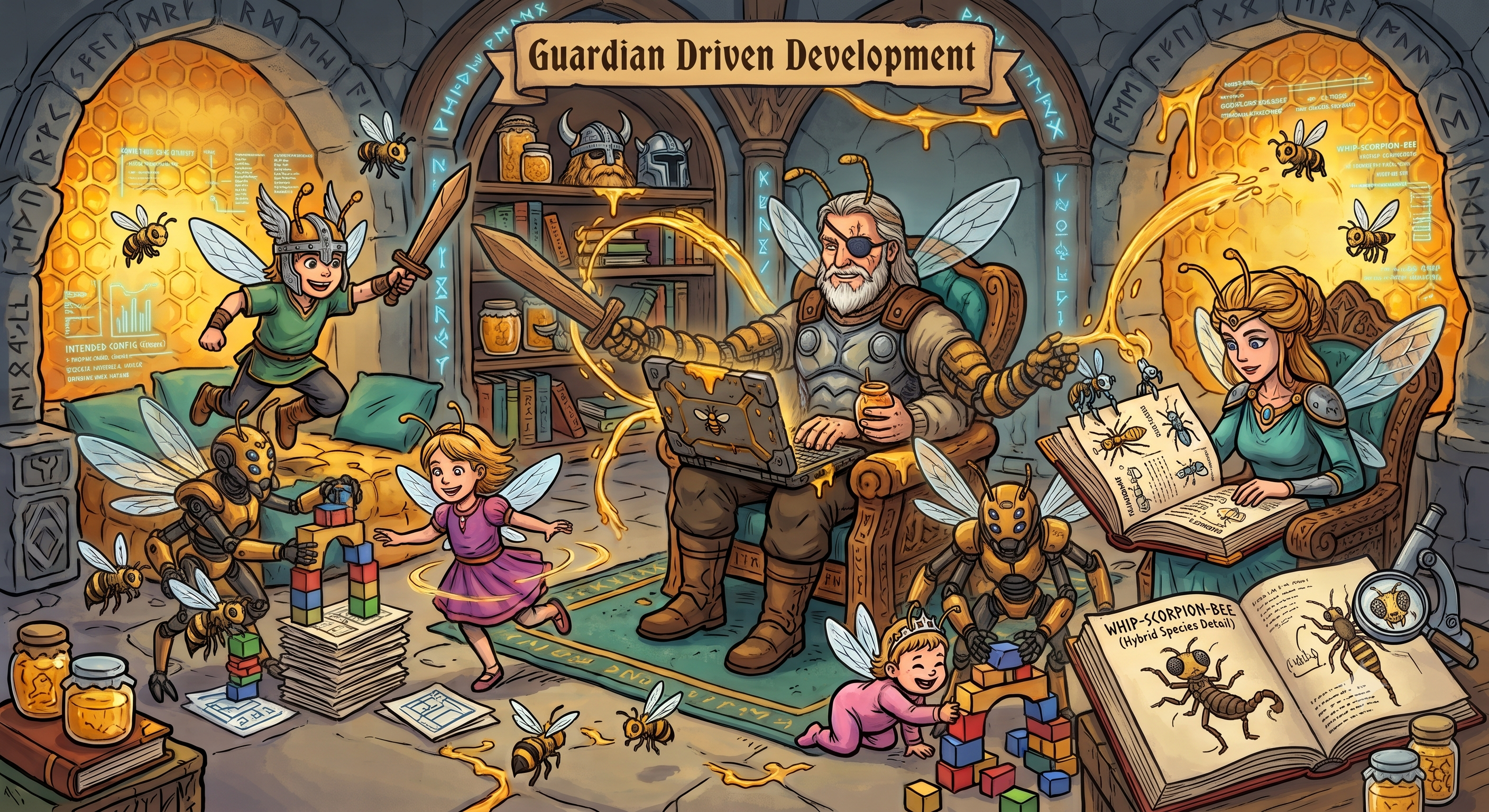
Welcome back to Beehalla. Growing extra arms may have started as an AI hallucination, now I ask for it on purpose to better represent the feeling 🐝
On July 21st, Guardian Driven Development hit 1.0. First tag the repo has ever worn, four months almost to the day after I first wrote about it here.
In February I wrote about carefully integrating AI into open source. In March I shared Guardian Driven Development (GDD) — a methodology for making that real...
In my last post I mentioned wanting to integrate AI into open source carefully — without pushing it on anyone, without letting it go wild in our repos, and w...
Re-arise blog! Arise!
On the fourth day of Xmas I went a bit insane …
On the third day of Xmas I wrote a bunch of stuff!
On the second day of Xmas my nerdy love led to me … writing https://github.com/Cervator/KubicTerasology - unsurprisingly a Kubernetes hosting setup for Teras...
On the first day of Xmas my nerdy love led to me … writing https://github.com/Cervator/KubicArk - a Kubernetes hosting setup for ARK!
A Trellorific Time
One more time